Interview:
Photographers Companion Magazine

PHOTOGRAPHY AS THERAPY
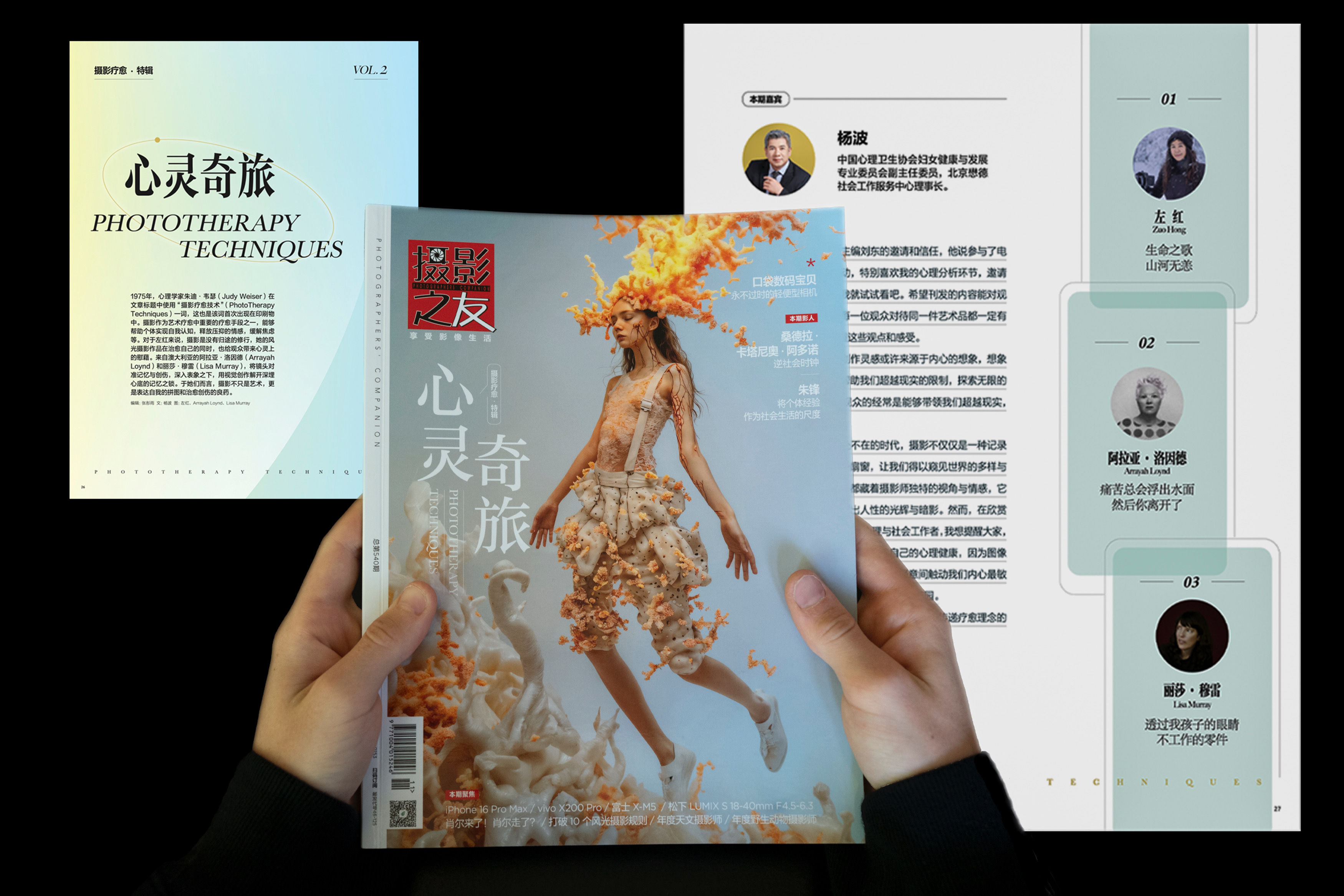
I was recently invited to contribute to a special issue for ‘PHOTOGRAPHERS COMPANION’, China’s leading photography magazine.
What initially started out as a straightforward interview about my series, ‘And Then You Were Gone’, evolved into an extended interview for a special issue of the magazine dedicated to ‘Photography as Therapy’.
It features three photographers that all use their artistic practice as a form of therapy – myself, my best mate and artistic twin, Lisa Murray, and Chinese landscape photographer, Zuo Hong. Lisa was invited to participate independently to myself (true story!) but I love the synchronistic way our work always ends up side by side. There is also a written contribution by Yang Bo, Vice Chairperson of the Women’s Health and Development Professional Committee of the Chinese Psychological Health Association.
The magazine showcases work from multiple series over the last couple of years for both Lisa and myself. The interviews have been translated into Chinese so we are unable to read the contributions of Zuo Hong and Yang Bo. Hopefully we can have this translated at a later date but for now here is the transcript of my interview in English.
Thank you Rain and the team at Photographers Companion.


Interview
RAIN: When did you become interested in photography and want to become a photographer?
ARRAYAH: I came to photography quite late in life after my kids had grown up. It was more about finding a creative outlet than photography itself. I had done some darkroom work in high school and loved it but it required a lot of time and patience to get a good result. Beginning again in digital format brought an immediacy to my work that I loved. I could photograph something and then very quickly begin working on it. This allowed my creativity to be actualised in a multitude of ways and to break all of the conventional rules that the darkroom imposed. I still don’t think of myself as a photographer but as an artist that utilises photographic means.
RAIN: How do you view the relationship between photography and memory?
ARRAYAH: People often refer to photographic memory. What does that mean? Are they able to see the past as clearly as the present with such precision and unwavering faith?
Memory is subjective. It very rarely tells us the truth and can’t be trusted or relied upon. Some would argue that the same can be said of a photographic image. My own memory is so porous that I need the tangibility of something solid to know that it ever existed.
Photographs can become artefacts of fact gathering, of piecing together a linear past to understand who we are and why we are. They are memory for so many of us. We are no-one without our memories.
RAIN: In the And then you were gone series, you presented personal, fragmented, and untouchable memories in visual form to the audience. What inspired you to create in this way?
ARRAYAH: It is how my mind works and how I experience the world. My mind lives in the ever present and circular now. That means that what came before is lost to me. If there are memories then they are often fragments that are unclear, jumbled up and out of sequence.
RAIN: Why did you think of using diptychs to express And then you were gone? What is the importance of this format in conveying the information you want to convey?
ARRAYAH: I often work in diptychs. I love the way two images can converse with one another in a way that tells more of a narrative than a single image alone. The synergy – the interplay of conceptual narrative, colour and form all seem to work in harmony in a way that calms my mind. I don’t know if it is my fixed neurodivergent mind or a conscious creative decision, but it works for me. Also, having two images side by side shows a conflicting or harmonious merging of those snippets of memory. I see them all as inter-changeable with other images in the series, pairing them as if I am trying to find the right match.
RAIN: Creativity is how you heal pain, how do you think photographers are going to stay creative with the rise of AI?
ARRAYAH: I think AI, used wisely, can be quite interesting. I haven’t used it myself and don’t feel qualified to give a definitive answer. I will say that you have to question your reason for creating. For me, it isn’t about the end result or the perfect image. It is about the process of creating that brings me the greatest satisfaction and where I find deep healing. To take that out of the equation would leave my art feeling empty and take away the whole purpose of why I personally create art.
RAIN: What is the significance of film photography in the era of digital photography’s popularity? How do you integrate film with digital photography?
ARRAYAH: I think there is always a nostalgia for the past, particularly for those that didn’t experience it the first time around. I love film photography and know it still has a powerful presence in the creative arts. I see some wonderful artists doing new and interesting things with analogue techniques and large format film. However, as a photographic teacher, I do despair at the lack of understanding (in some quarters) that you still need to process images beyond just the negative being scanned.
My use of analogue is not at all conventional. it is necessarily ad hoc in its digital capture. To be to a purist and scan the negatives would remove so many of the elements that others would want removed but to me add to the concept and feeling I want to convey. I want the dust, the blurs, the curling of the edges, the backgrounds bleeding into the image. I never want perfection; I much prefer seeing all of the debris and chaos.
RAIN: How do you balance the expression of self-awareness with the resonance of the audience? Or what perspective or mentality do you think the audience should adopt when interpreting your work?
ARRAYAH: I experience the world and live my life based on feeling. That is my truth and it informs everything I do. This series lets go of the literal and asks the viewer to stop thinking for a moment and experience the work on a visceral level. They may walk away with a different interpretation than was intended but that is ok. It can be seen as an extension of the concept in the same way that two people can experience the same event and yet have different memories emerge from it. We filter everything through our own personal experiences. That said, I do hope it gives a little insight into what the world looks and feels like to those of us that are neurodivergent.
RAIN: Which photographers or artists have had a significant impact on you in the process of teaching and creating photography?
ARRAYAH: I love anything that pushes the boundaries of what photography can be, whether that is traditional or experimental. I am drawn to imagery that moves me, makes me feel something even if that feeling is discomfort.
I am mostly inspired by my own internal imaginings than any one specific artist. It is the explosion of colour and ‘sparkly’ things inside my head that keeps me endlessly inspired. So many ideas and not enough time. I am a highly visual person and see all the infinite possibilities within my mind’s eye and never run out of new ideas. The dopamine hit is real!
Some of the artists that excite me with what they are creating are: Lisa Murray, Melanie Schoeniger, Henri Blommers, Ludovica De Santis, Stephanie O’Connor, Stefanie Langenhoven, Adrian Saker and so many more.
RAIN: Do you have any suggestions or experience sharing for women who want to work in the photography industry?
ARRAYAH: I’m not involved within the photographic industry so unable to offer any real suggestions in that regards. As an artist, the best advice I can give is to find subject matter that is meaningful to you. The world has enough pretty pictures so focus instead on finding your unique voice and visual language. Push through the boundaries of what you have been taught. Experiment with abandon, that is where the magic lies.
RAIN: What new themes do you want to try in the future?
ARRAYAH: I work very closely with Photographic artist Lisa Murray. We share our ideas and work with each other daily. We have been talking about creating a new series together that is more planned and intentional in regard to the shooting of the project. We are like one brain and have the same ideas at the same time. She is my creative twin. We are both neurodivergent and want to create a body of work that really expresses and celebrates who we are.
RAIN: Do you have any special meaning or thinking behind the choice of using many blurred and either under or overexposed film negatives in your creative process?
ARRAYAH: Using the old, discarded negatives formed the basis of my series. Photographing photographs as if to consolidate memory into something more solid and real. Nothing seems clear when you look at these flawed negatives. Yet the strangest things form to become fragments of a new or altered truth. I am forever questioning myself, “Did I just make that up?”.
RAIN: You mentioned holding the negatives up to different light sources,would you please share some specific technical and creative processes?
ARRAYAH: I really wanted to play around with the idea of using the older analogue elements of my work by simply holding the negatives in my hand and photographing them digitally against various light-filled backgrounds – some against artificial light at night and others against a backdrop of sky and trees.
I used all the negatives that I would normally discard in the dark room – blurred, over or under exposed, scratched, badly cropped, etc. It added to the concept of unformed memory and makes visible the things that I latch onto when trying to work out if I know someone or not. Limbs, items of clothing, hair, a fragmented or blurred face.
Most of the images within this series have had minimal processing beyond basic editing and the application of colour. Others are layered images, combining the photographed negatives with old proof sheets and images from my digital archive, blended and coloured to give an insight into my experience of the world through a neurodivergent lens. It is messy, and confusing…just like my mind.
RAIN: How did your perceptions and memories of your surroundings change during the epidemic lockdown, and how did this affect your photography?
ARRAYAH: Lockdown is when my real creative journey began as it forced me to turn the camera on myself. It is when I got my formal diagnosis, accidentally discovered my prosopagnosia and inherited some family archival imagery that formed my series ‘Come and Find Me’, work very much centred on memory and otherness.
Creating that series forced me to really question my past and my fragmented or non-existent memories. Having time away from the push and pull of the external world gave me the space to do that. I got to see myself in a new light. It was painful and uncomfortable but ultimately it gave me the gift of understanding who I really was.
RAIN: You work from an archive of old negatives and construct an alternative to “photographic memory.” What does this process mean to you personally?
ARRAYAH: I worked with my archival film negatives for this series. I created a juxtaposition between the concept of photographic memory and the experience of prosopagnosia (face blindness) and neurodivergence. I have never been able to remember faces and I get people mixed up all the time. I can usually remember a voice or vocal mannerisms, even a distinctive piece of clothing helps. It is like an anxiety-riddled game of ‘Guess Who’ and it is exhausting.
But then I get to twist and pull it all apart to see what fits together as I try to build a portrait of the people whose faces I am unable to place. Sometimes it works and sometimes not. This process has shown me how hard I work at trying to remember and how difficult that can be when you unable see the whole picture.
RAIN: The Vol.I of Pain always finds the surface centres around your struggle, while in the Vol.Ⅱyou find the light between the cracks and fissures of your mind. What prompted this transformation to occur? How do you express the connections and changes in this series through visual means?
ARRAYAH: Looking back at the series now, It is really interesting to me how visible the contrast is from one volume to the other.
Vol.I was very much about my dissociative state and the separation of my consciousness from my physical self during a very traumatic time of my life. The beautiful soft colours belie the pain that I was experiencing. There is a melancholy to the work, a deep sadness that can be felt but that is masked by the dream-like qualities of the images themselves. The work was necessarily soft, so thick with pain but elusive in its focus. I was creating a visual sanctuary to keep me safe from something so powerful that it had the potential to destroy me.
The images for Vol.II were taken on a day when my husband managed to get me out of the house. We drove up into the hills and stopped at a natural watering hole amongst giant granite boulders. It was a beautiful sunny day and the act of photographing and focusing on something external was so beneficial for me mentally.
The work I created for Vol.II looks very dark and forbidding compared to Vol. I. I think it expresses the beginning of being able to look at the pain without losing myself. To see its darkness and edges and feel it without being overwhelmed or swept away back into that place of safety deep within my mind. The visual darkness of the imagery allows you to see those small shafts of light, contrasting so brightly with the heaviness of the trauma it is pushing through.
RAIN: What role does photography or artistic creation play when you face pain?
ARRAYAH: I experience extreme sensory overload and emotional dis-regulation when I am overwhelmed with emotion or physical pain. It is all consuming and my brain dissociates as a protective mechanism. Creating art seems to be the only way I can access and process what is happening for me internally. It is as essential to me as breathing.
Pain has been a constant part of my life and there have been only a few rare moments where I have felt well. Combine that with being neurodivergent and it can be debilitating both mentally and physically.
Pain Always Finds the Surface Vol.I was one of those moments where I was deeply distressed after another traumatic hospital visit. I started creating it whilst still affected by the medication I had been given and experiencing a dissociated state. I was desperately trying to cling on to reality and unable to process what was happening within me. Picking up the camera was instinctive and I used it as a way to help bring me back into my body. What got me through was my art, processing the pain through my image-making.
It was during this time that I connected with another photographer, Lisa Murray, who works in a very similar way to me artistically. She seems to mirror my mind and life experiences and we work together every day in friendship and our creative practice. Being able to share my life with her in this way has been profoundly healing and I don’t know how we both managed before. Having someone that can be honest with you and encourage you in moments of doubt has allowed me to reach even higher that I ever could alone.
RAIN: How do you view photography therapy?
ARRAYAH: Being creative is therapy. It’s kind of like putting together a jigsaw puzzle, finding the right pieces that fit together aesthetically and emotionally for whatever you need to process in that moment.
I often have a burning need to express something that I am unable to process within my mind or body and art seems to be the only way I can do this. I can often overthink things but creatively I am able to be completely free and in the moment, accessing a part of me that needs to be heard and understood.
Not everything I produce is worthy of publishing but it still serves a purpose for me and helps me to find my place in a world that I find completely overwhelming. It gives me a voice when I am rendered mute and unable to find my words.